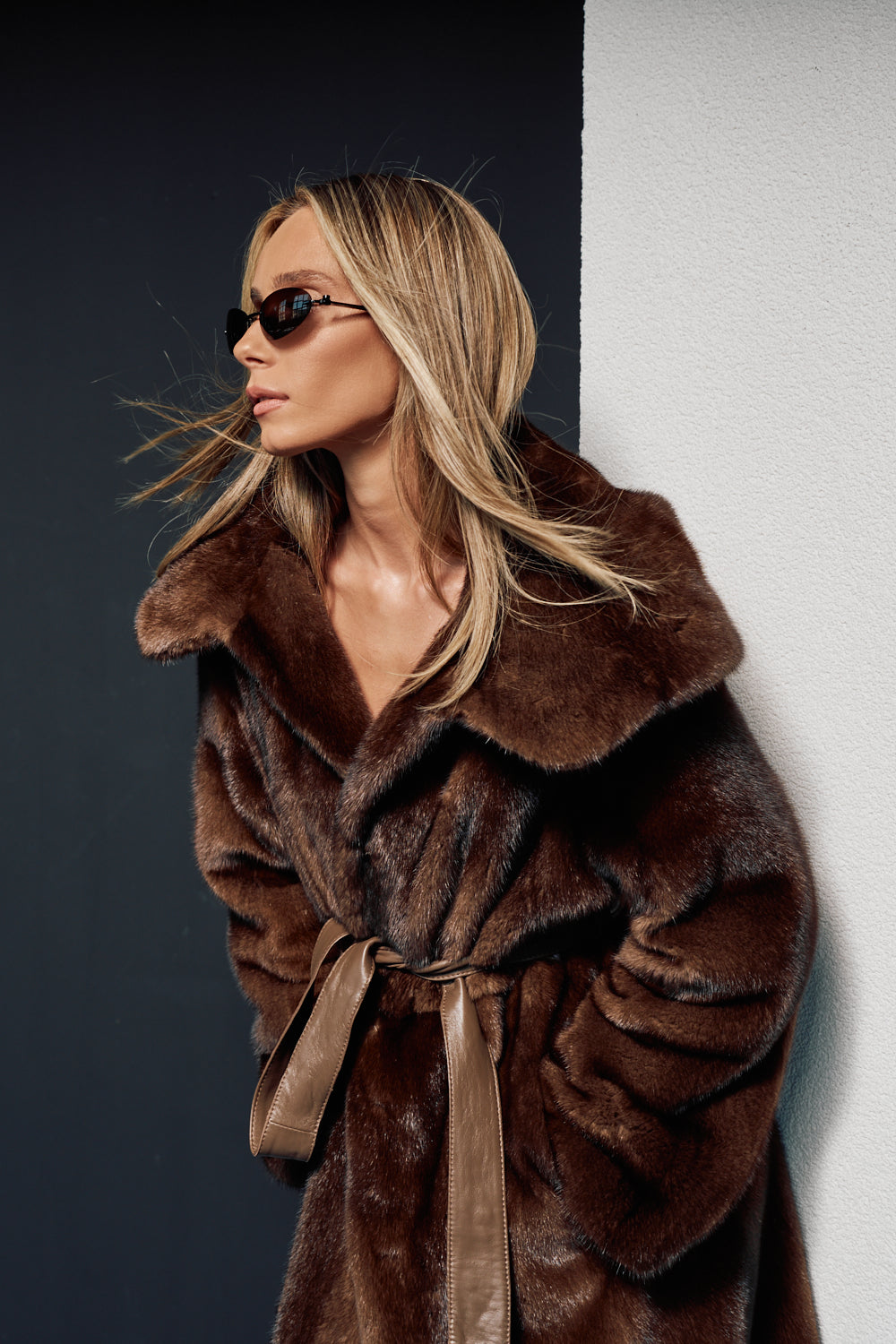




Furmark for natural fur: What is certified and how to check traceability
“How can I find out where the fur comes from and what standards were followed?” is one of the most important questions before buying a premium piece. The answer cannot be reduced to a logo or to phrases such as “ethical fur” and “responsible origin.”
This article refers to Furmark, the certification and traceability system for natural fur, not to the software program of the same name used for testing hardware components. We will explain who administers the system, what it checks, what role farms, auction houses, and processors play, and how the buyer can verify the information associated with a garment.
What is Furmark and why was it created

Furmark is an international certification and traceability system for natural fur, which brings together several programs regarding animal welfare, processing, and material tracking through the supply chain.
The system was developed by the International Fur Federation, also known by the abbreviation IFF. It is not a single inspection applied identically to all types of fur, but rather a framework that brings together different programs, with protocols adapted to species and regions. According to Furmark documentation, these programs must have standards based on scientific data, third-party assessments, and recognized certification bodies.
Who administers the Furmark system
Furmark was created by IFF together with representatives of the value chain and of brands that use natural fur. The framework is governed through IFF structures, and the programs that wish to be included must meet the established requirements.
The administration of the system should not be confused with the assessment of each farm. Inspections and certifications are carried out by the programs and bodies competent for the respective region, species, or stage.
What types of fur and what stages it can cover
The framework includes programs for fur coming from farms and from wild sources, depending on the species and region. Among these are WelFur for European mink, fox, and Finnish raccoon dog farms, programs in North America, as well as programs for Swakara, sable, chinchilla, and wild nutria.
The system also includes requirements for processors who preserve, finish, or dye the leather. Therefore, Furmark certification is not limited, in principle, to the origin stage.
Furmark certification and a product label are not the same thing
Four levels must be distinguished:
-
farm or source certification;
-
processor and dye shop certification;
-
chain of custody documentation;
-
label and code associated with the finished product.
A certified farm demonstrates that it has been assessed according to the applicable program. This does not automatically mean that any garment made later from that raw material can bear the Furmark label. For the finished product, the subsequent path must also be documented.
How certification works, from origin to finished product

Fur origin and source certification
The applicable standard depends on the species and the region from which the material comes. For example, European mink, fox, and Finnish raccoon dog farms can be assessed through WelFur, while other regions and types of fur have distinct programs.
Therefore, the phrase “certified origin” must be accompanied by concrete information: what program was used, what species it covers, and what body carried out the assessment.
The role of auction houses
An auction house represents an important point for collecting, sorting, documenting, and commercializing leather. It can group the raw material into lots, record its origin, and transfer the information to buyers and processors.
Saga Furs is a relevant example, but it is not synonymous with Furmark. The company is an auction house that operates its own certification and documentation systems, integrated into the broader Furmark framework. According to official Saga Furs information, all skins sold at its auctions are certified, and the system is verified through third-party audits.
Processing, dyeing, and substance verification
Traceability should not stop at the farm or the auction house. Preservation, finishing, and dyeing represent separate industrial stages, in which chemicals and specialized equipment can be used.
According to the requirements published by Furmark, certified processors and dye shops must comply with rules regarding the substances used, the conformity of the finished product, laboratory tests, inspections, and the documentation of the leather's movement. The system also requires tracking the chain of custody throughout processing.
Manufacturing and labeling the final product
The manufacturer must record the receipt of the certified material and its use in the product. For a garment to be presented as a Furmark product, it is not enough for the raw material to come from a certified lot if the subsequent stages are not documented according to the system.
The finished product label must be associated with the information available on the traceability platform. In its absence, the retailer must clearly state whether the certification covers only the raw material or the entire path.
What fur traceability means

Traceability represents the ability to track the origin and movement of a material through the documented stages of the supply chain, from the source to the finished product.
Fur traceability is not just a statement about the country of origin. It involves maintaining and transferring information between the source, auction house, processor, manufacturer, and retailer.
What information a traceability system can provide
Depending on the system and the product, the following information may be available:
-
species;
-
country or region of origin;
-
certification program;
-
lot;
-
manufacturer;
-
place of manufacture;
-
documented processing stages.
The level of detail varies. The identification of the individual farm for each garment should not be promised if this information does not appear in the product's concrete code.
How the material is tracked through the chain of custody
The path can be summarized as follows:
-
The certified source provides the leather.
-
Lots are recorded and commercialized through an auction house or another documented channel.
-
The processor records the receipt, preservation, finishing, and, if applicable, dyeing.
-
The manufacturer records the material used in manufacturing.
-
The product receives a label and a verifiable code, if it is fully included in the system.
Furmark states that labels are linked to digital records and that the movement of the material is documented through the supply chain. Since January 12, 2026, the official traceability infrastructure is supported by the Digital4U Furmark Platform, which associates physical labels with digital information accessible to participants and consumers.
Why traceability is not the same as sustainability
A product can have a documented origin without this automatically answering all questions about impact. Traceability provides information and the possibility of verification, but it does not establish on its own what sustainability means for each buyer.
Environmental impact, animal welfare, substances used, processing conditions, and lifespan must be analyzed separately. Traceability is a tool for transparency, not a universal conclusion.
Furmark, WelFur, and Saga Furs: what is the difference

|
Term |
What it represents |
What it does not represent |
|
Furmark |
International framework for certification and traceability of natural fur |
An auction house or a single protocol applied to all sources |
|
WelFur |
European program for assessing welfare in mink, fox, and Finnish raccoon dog farms |
Complete certification of the finished product |
|
Saga Furs |
Auction house that sells certified lots and documents origin |
The authority that administers all of Furmark on its own |
|
Traceability |
Documenting the origin and movement of the material |
Automatic proof that the product is sustainable in all respects |
WelFur assesses farms based on four principles: suitable housing, suitable feeding, good health, and appropriate behavior. For initial certification, three visits are provided at different times in the production cycle, followed by periodic maintenance assessments. Inspections are carried out by third-party assessors.
What the phrase “ethical fur” really means

Why “ethical” is not a sufficient certification
“Ethical fur” is not a universal technical category. Ethics includes different personal values and limits. For some people, the use of natural fur is unacceptable regardless of certification. For others, controlled origin, animal welfare, product lifespan, and transparency are relevant criteria.
The role of information is not to decide in place of the buyer. They must be able to see what has been verified and what remains a personal choice.
What a certification can demonstrate
A certification can demonstrate:
-
the existence of defined criteria;
-
the application of a protocol for the respective species or stage;
-
the performance of assessments;
-
the participation of third-party bodies;
-
the documentation of certain stages of the chain.
The correct statement is that the product or source has met the criteria of the applicable program, not that every ethical question has received a definitive answer.
What certification cannot demonstrate on its own
Certification cannot:
-
eliminate the ethical debate;
-
guarantee zero impact on the environment;
-
demonstrate that any fur product is sustainable;
-
replace the verification of the concrete garment;
-
guarantee cut, comfort, or lifespan;
-
automatically confirm every statement made by the retailer.
How to verify the traceability of a fur garment

Check the label and individual code
Look for the Furmark label and the individual “Trace Now” code or the verification platform indication. The code may appear on the inner label or on the documentation accompanying the product.
Enter the code into the platform indicated by the label and check if the displayed information corresponds to the species, product, and retailer. A logo without a functional code requires clarification.
Ask the retailer for precise information
Useful questions are:
-
What species of fur was used?
-
What is the country or region of origin?
-
What certification program applies?
-
Is there a verifiable traceability code?
-
Who processed the material?
-
Who manufactured the product?
-
Does the certification cover the finished product or only the raw material?
In the case of a premium piece, including when analyzing the Mareus selections of natural fur garments, useful information is not limited to appearance and cut. Species, material origin, and available documents should be discussed separately.
Do not confuse a quality label with proof of origin
A brand label, the name of a collection, or the phrase “premium fur” does not replace traceability documents. Visual quality and certified origin are different criteria.
Mentioning an auction house does not automatically prove the complete path of the product. The information must be associated with the concrete lot or code.
Signs that require further clarification
Ask for explanations when you notice:
-
vaguely presented origin;
-
inability to identify the species;
-
use of the terms “ethical” or “sustainable” without criteria;
-
acronyms without a code or documentation;
-
promises such as “zero impact”;
-
contradictory answers about origin;
-
confusion between raw material certification and finished product certification.
Why traceability matters when buying a premium piece

Traceability reduces the distance between a marketing promise and verifiable information. Instead of a general statement about responsibility, the buyer can request data about species, origin, processing, and route.
A high price does not prove controlled origin on its own. Documenting the chain provides an additional criterion for assessing the relationship between price and value.
Traceability also creates accountability in the supply chain. If participants and transfers are recorded, non-compliance can be located more easily.
Most importantly, transparency allows the buyer to make their own ethical decision. It does not dictate the choice, but makes it more informed.
Frequently asked questions about Furmark

Does Furmark certify all natural fur clothing?
No. The system applies to sources, processors, manufacturers, and products that participate in and meet its requirements. A piece of natural fur clothing does not automatically become a Furmark product simply because of the nature of the material.
Are Furmark and Saga Furs the same thing?
No. Furmark is the international certification and traceability framework developed by IFF. Saga Furs is an auction house that trades certified lots and operates its own certification and documentation systems integrated into this framework.
What is WelFur?
WelFur is a European program for assessing and certifying welfare in mink, fox, and Finnish raccoon dog farms. It analyzes housing, feeding, health, and behavior through third-party assessments.
Does a Furmark label guarantee that the fur is ethical?
The label shows that the system's criteria and verifications have been applied to the documented stages. It does not answer all moral questions and cannot determine in place of the buyer whether the use of fur is acceptable.
Can the origin of a piece of clothing be checked online?
Yes, if the product has a valid Furmark label and traceability code. The available information may vary, and the code should not be assumed to identify the individual farm if the platform does not display this level of detail.
Does Furmark guarantee the quality of the finished product?
No. The system aims at certification and traceability, not the cut, fit, comfort, or durability of all components of the clothing. The finished product must be assessed separately.
Does traceability automatically mean sustainability?
No. Traceability documents the origin and movement of the material. Sustainability also involves environmental impact, production conditions, resource use, lifespan, and repair options.
Conclusion

Furmark provides a framework for certifying, verifying, and tracking natural fur through the supply chain. It brings together programs tailored to different species and regions, includes processing requirements, and uses labels associated with digital information.
The system does not end the ethical debate or automatically turn any certified product into a sustainable one. A documented purchase begins with concrete questions about species, origin, certification program, processing, manufacturer, and product code.